



QUALITY SCORE EXPLAINED

WHAT IS QUALITY SCORE
• Quality Score is a Google Ads feature that measures how well your ad will perform.
• Quality Score is rated on a scale from 1- 10.
• The higher the Quality Score, the more successful the advert.
• Benefits of having a high Quality Score:
A. Lower Cost-Per-Clicks
B. Higher-Ranked Positions
C. More Sales and Leads.

FACTORS THAT INFLUENCE QUALITY SCORE

EXPECTED CLICKTHROUGH RATE

‘Expected click-through rate’ measures the likelihood of people clicking on your advert.
Google considers Ad text, Keywords, and Historical data to determine your expected click-through rate.
It lists one of the following:
• Above Average
• Average
• Below Average

AD RELEVANCE
Ad Relevance determines how well your ad aligns with the searches/keywords entered by users.
If users apply the ‘same keywords’ also found in your ads, your Ad Relevance will be high.
It lists one of the following:
• Above Average
• Average
• Below Average

LANDING PAGE
‘Landing Page’ determines the value of your website based on how users interact with it.
Landing pages require fast download speeds, easy navigation, quality content, and mobile-friendly designs.
It lists one of the following:
• Above Average
• Average
• Below Average

FREQUENTLY ASKED QUESTIONS

Why is Quality Score important?
A higher score lowers your cost-per-click (CPC) and improves your ads position.
How is Quality Score calculated?
It’s calculated based on expected click through rate (CTR), ad relevance, and landing page experience.
Does Quality Score affect ad auctions?
Yes! Higher scores give you better placement and lower costs (CPC) in the auction.
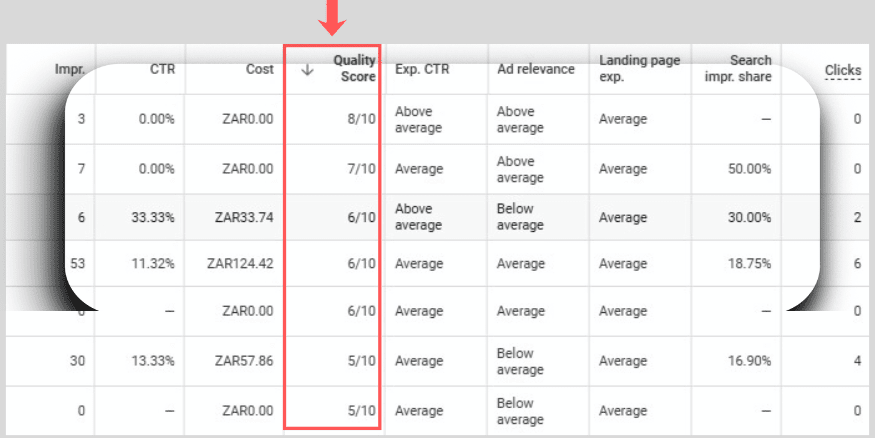
Where can I see my Quality Score in Google Ads?
Yes! Go to your Keywords tab in Google Ads and check under the Quality Score column.
How can I improve my Quality Score?
There are multiple ways to increase your quality score such as:
– Improving your ad copy
– Matching keywords to search intent
– Optimizing landing pages.
Do Quality Scores change over time?
Yes. Google updates them based on ongoing performance and user behavior.